

It’s mid January in Pasadena, and Tom Hanks and Steven Spielberg are standing in a corner as HBO runs a promo reel to TV critics of its epic 10-part miniseries The Pacific. Hanks is beaming with pride. Then the lights go on and Hanks and Spielberg jump to the stage to begin fielding a firestorm of questions. The press conference culminates Spielberg, Hanks and Gary Goetzman’s six-year project, which they embarked on not long after their award-winning miniseries Band of Brothers.
I ask Hanks what was running through his mind while watching the reel and he smiles. “It’s funny,” he says. “You hand it over and they always come up with new juxtapositions and connections because other people look at the material — I was knocked out by it.”
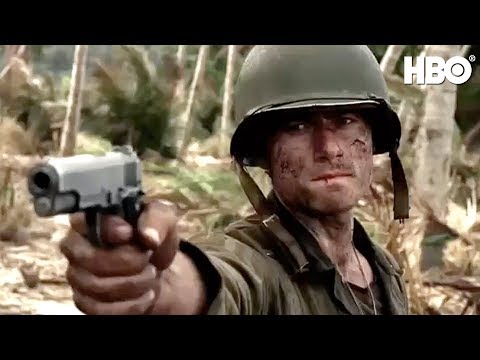
And so were we TV critics. From the opening score and title treatment you realize this project is unlike any other war feature film you’ve seen. Each one-hour episode begins with a much-needed narrative (provided by Hanks) that introduces you to Pacific isles you never knew existed, summarizing dates, locations and the battle stories that were about to unfold. The narrative takes just minutes and then it quickly moves to the human element of the war, depicting the real-life experiences of three U.S. Marines — Robert Leckie (played by James Badge Dale), Eugene Sledge (Joe Mazzello) and John Basilone (Jon Seda). The series follows them from their enlistment to their first battle with the Japanese on Guadalcanal, through the rainforests of Cape Gloucester and devastation of Peleliu, across the bloody sands of Iwo Jima and through the horror of Okinawa, and ultimately to triumph and their return home.
Almost unbearable to watch at times, as the magnitude and the intensity of these battles was so bloody and devastating, the series doesn’t waver in depicting the true human cost of war.
“I think what moved us to tell these stories based on these survivors, these veterans, was, in essence, to see what happens to the human soul throughout this particular engagement,” Spielberg says. “These islands were steppingstones to the mainland of Japan. These islands were all steppingstones. And the warfare that we were trained to fight — we weren’t trained by the drill instructors stateside, except what they could glean from recent history. We were trained by the enemy, how to fight the enemy. They trained us how to fight like them. And because of that — and I don’t want to compare one war to the other in terms of savagery — there’s a level when nature and humanity conspire against the individual. And to see what happens to those individuals throughout the entire course of events, leading up to the dropping of the two atomic bombs, is something that was very, very hard, I think, for the actors and for the writers and for all of us to put on the screen. But we felt we had to try.”
Hanks says the war in the Pacific is more like the wars we see today.
“A war of racism and terror, a war of absolute horrors, both on the battlefield and in the regular living conditions,” says Hanks. “The challenges that we put forward to ourselves at the beginning of all of this was to take human beings and put them through hell and wonder how in the world they would approach the world when they came back.”
Jon Seda plays John Basilone, one of our country’s many heroes of the war. Seda found the experience to be utterly humbling. “I almost couldn’t watch [the clip]. I got teary-eyed. We’ve kind of been living with this for almost three years now. It’s really emotional.

“I’ll never forget the first day of boot camp. Tom Hanks came out and gave a pep talk. He said a lot of great things. The one thing I remember the most that he said to us, and there was about a hundred, 200 of us at boot camp, some were big roles, some small, some who didn’t even know what they were going to do. He said, ‘Everyone here is just as important as the next. If you are in a scene and you’re not saying anything, these things are so big and huge they are going to capture everything.’ We all went through the same training. Everyone just gave 100 percent and brought their hearts to the set. They had the look and feel of what the war was doing to them. When he said that, it really inspired me.
“This isn’t like any other job,” Seda continues. “This isn’t like making a TV show. When I signed on to do this, I wasn’t thinking about what this would mean for me or my career or anything like that; it was just me trying to do the best I could and be the voice of Basilone. Watching that and seeing it put together like that, man, it’s an honor. It’s an honor to be a part of this.”
And, it’s an honor to be able to view The Pacific beginning March 14 on HBO (HD) and HBO On Demand March 15. New episodes air on HBO every Sunday.
The Pacific Episode Guide


Jon Seda. Credit: Bruce W. Talamon/HBO
The Pacific, Part One
Debuts: March 14, 9pm ET/PT
In the immediate aftermath of the Japanese attack on Pearl Harbor, Marine Sgt. John Basilone prepares to ship out and confront the enemy somewhere in the Pacific, while budding journalist Robert Leckie enlists in the Marine Corps. Eugene Sledge, unable to enlist because of a heart murmur, says farewell to his best friend, Sidney Phillips, who is about to leave for boot camp. Exactly eight months after Pearl Harbor, the 1st Marine Division, including Leckie and Phillips, lands on Guadalcanal in order to secure its strategically vital airfield and prepare for the inevitable counterattack.


Joshua Bitton, Jon Seda. Credit: David James/HBO
The Pacific, Part Two
Debuts: March 21, 9pm ET/PT
Basilone and the 7th Marines arrive on Guadalcanal to reinforce Leckie and the rest of the 1st Marine Division as they continue to defend the crucial airstrip. Basilone plays a key role in repelling a nighttime Japanese attack, but suffers a frightful personal loss. After four months of continuous action, the exhausted and disease-ridden members of the 1st Marine Division are evacuated off the island.


James Badge Dale, Jacob Pitts, Keith Nobbs. Credit: David James/HBO
The Pacific, Part Three
Debuts: March 28, 9pm ET/PT
Physically and mentally debilitated after the four-month ordeal on Guadalcanal, Leckie, Basilone and thousands of their comrades land in Melbourne, where they are greeted by adoring crowds and viewed as the saviors of Australia. While his buddies carouse, Leckie becomes deeply attached to an Australian woman and her first-generation Greek family. Meanwhile, Basilone is awarded the Medal of Honor and is asked to return home to help sell U.S. war bonds.


(clockwise from top left) Tom Budge, James Badge Dale, Jacob Pitts, Joshua Helman, Ashton Holmes. Credit: David James/HBO
The Pacific, Part Four
Debuts: April 4, 9pm ET/PT
Finally enlisted as a Marine, Sledge trains for combat at Camp Elliott. The 1st Marine Division lands at Cape Gloucester on the Japanese-held island of New Britain. As Leckie and the other Marines battle the Japanese, they quickly realize that the more ominous enemy is the smothering jungle itself. Having survived Gloucester and stationed on the godforsaken island of Pavuvu, Leckie begins displaying the physical and mental effects of combat and is sent to a naval hospital on nearby Banika for psychiatric observation.


Jon Seda, Anna Torv. Credit: David James/HBO
The Pacific, Part Five
Debuts: April 11, 9pm ET/PT
Basilone’s celebrity grows as he travels across the country on the war bonds tour. On Pavuvu, Sledge, assigned to the 5th Marines, 1st Marine Division, is briefly reunited with Phillips and Leckie rejoins his company. Sledge then gets his first taste of combat as he, Leckie, and the rest of the 1st Marine Division meet fierce Japanese resistance while landing on the intricately and heavily defended coral island of Peleliu.


Credit: HBO
The Pacific, Part Six
Debuts: April 18, 9pm ET/PT
Despite the suffocating 115-degree heat and a lack of clean drinking water, Sledge, Leckie and the other Marines confront the highly-fortified enemy as they attempt to capture the Peleliu airfield. After seeing his comrades badly injured, Leckie himself is wounded and evacuated from the island. Sledge witnesses the shocking truth about what is sometimes required to survive and fight another day.


Credit: David James/HBO
The Pacific, Part Seven
Debuts: April 25, 9pm ET/PT
The Marines, including the newly christened “Sledgehammer,” continue the battle of Peleliu against an enemy determined to fight to the last man. Devastated by the loss of a revered leader, and witnessing unimaginable barbarity on both sides, Sledge veers to the very edge of moral collapse. Their objective finally secured, the Marines return to Pavuvu fundamentally changed by their experience on Peleliu.

Annie Parisse, Joe Mazzello. Credit: Bruce W. Talamon/HBO
The Pacific, Part Eight
Debuts: May 2, 9pm ET/PT
Increasingly frustrated by his role campaigning for war bonds, Basilone convinces the Marines to allow him to train troops headed for combat. Transferred to Camp Pendleton, he enjoys a whirlwind romance with an initially reluctant female Marine, Lena Riggi. But the couple know they are living on borrowed time, as Basilone is soon to take part in the Marine landing on Iwo Jima.


Brendan Fletcher, Joe Mazzello. Credit: David James/HBO
The Pacific, Part Nine
Debuts: May 9, 9pm ET/PT
After battling across the island of Okinawa for over a month, Sledge and the rest of the 1st Marine Division are ordered to relieve an Army division that has been in combat against the most strongly defended Japanese position on the island. The primordial conditions and the moral dilemma posed by the presence of civilians put tremendous strain on the physical and psychological endurance of Sledge and the other Marines.

Joe Mazzello, Conor O’Farrell. Credit: David James/HBO
The Pacific, Part Ten
Debuts: May 16, 9pm ET/PT
After the Japanese surrender, Leckie, healed from his wounds, leaves the hospital and returns home, while Sledge heads back to Alabama to be reunited with his family and Sid Phillips. Lena visits Basilone’s home and has an emotional meeting with his family. Leckie adjusts to post-war life by resuming his old job and starting a new relationship, but for Sledge, unsure why he survived the war seemingly unscathed, adjustment will require more time.