



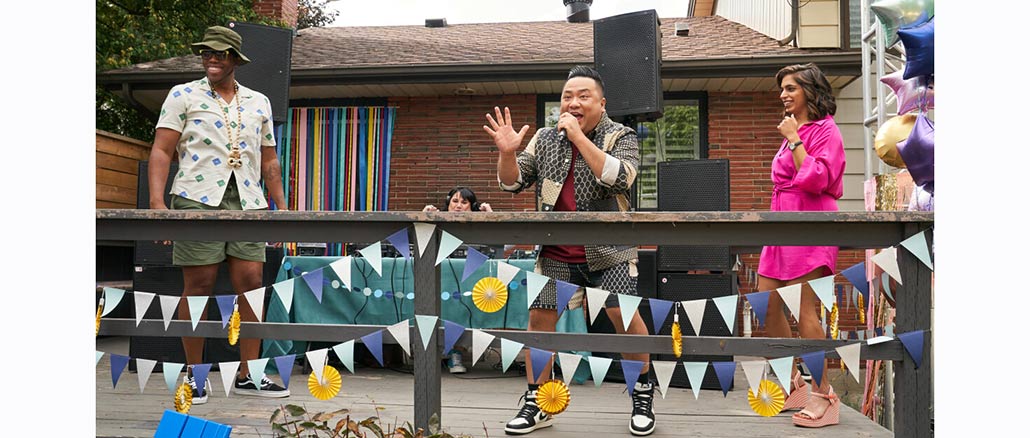

The suburbs have gotten a bad rap. “When they were shown on television, suburbs were a place where people went to die. [They were] so mundane and boring,” says Andrew Phung, star and cocreator of the Canadian import Run the Burbs, which premieres Monday, July 31 at 8:30pm ET/PT on The CW. “But for so many people, the suburbs are a place you go to actually thrive.”

His comedy, about a contemporary Vietnamese-South Asian family living life to the fullest in the ’burbs, makes its U.S. debut with a feel-good sense of humor and an upbeat attitude. You don’t have to be Canadian or Vietnamese or even an immigrant to enjoy the show — it’s relatable because it’s about family.
Or in this case, Phamily. The Pham patriarch is Andrew (Phung, Kim’s Convenience), who’s been a stay-at-home dad for 14 years. “He’s trying to find his purpose. He’s questioning [whether] his kids need him as much as they did be- fore,” says the actor. As for entrepreneurial mom Camille (Rakhee Morzaria): “She’s worked this job and she’s got a pull in a different direction, so she’s figuring out what she wants to do with her career.”
The slice-of-life vignettes that open each episode set the hilarious tone. In the premiere, the family struggles to get a trunkful of groceries into the house in “One trip!”— words he triumphantly crows to the neighbors after they’re successful. And in Episode 2, Andrew, Camille and teen daughter Khia (Zoriah Wong) try to register young son Leo (Roman Pesino) for day camp. “Literally it’s them on nine computers,” Phung says, adding that after the episode aired in Canada, “So many parents reached out and they’re like, ‘This is too real.’ If you have kids, you’ve lived this.” In the same half hour, high temps lead the Phams to try to find a neighbor with a pool, a quest that originates in the deep end: “If you have a pool, your status in the neighborhood immediately goes up!” Phung says.
As depictions of suburbia go, “families of color were often left out,” Phung observes. “What I love about the show is we’re pivoting the camera one house over to the family that’s always existed in your neighborhood.”