
 HBO
HBOThe world was warned in 1968.
Scientists predicted that bacteria and viruses weren’t the world’s biggest threat, but rather a fungus that would inhabit any living life-form and, in humans, act like a puppeteer taking control of their bodies and poisoning their minds. That fungi wouldn’t kill, however, it would try to spread to every last human alive by any means necessary.
But no one believed that ever would be possible.
That is, until Sept. 26, somewhere around 2013, when we first meet single father Joel Miller, played by Pedro Pascal (The Mandalorian), whose world comes crashing down on his 36th birthday after the fungus reaches the United States in HBO’s The Last of Us (premiering Sunday, Jan. 15, at 9pm ET/PT).
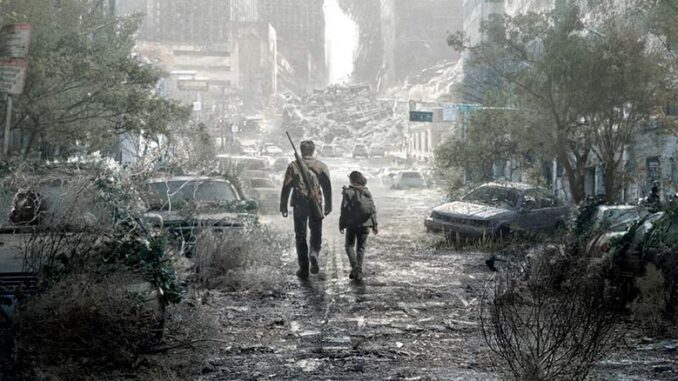
From that fateful day, the series jumps 20 years ahead to a world where modern civilization has been destroyed. Joel is now a hardened survivor who’s tasked with smuggling a 14-year-old girl named Ellie (Game of Thrones’ Bella Ramsey) out of an oppressive quarantine zone. The series is an emotional, brutal and heartbreaking journey of survival — all based around a popular video game of the same name.
The nine-episode first season comes from the Emmy Award-winning creator of Chernobyl, Craig Mazin, and the creator of the acclaimed video game, Neil Druckmann. We caught up with these two geniuses as they shared some exclusive insights on what’s to come.
When developing the video game, did you have a TV series in mind from the get-go?
Neil Druckmann: No, not at all. When we made the game, we were already quite in the thick of it with trying to adapt Uncharted [the 2022 Tom Holland/Mark Wahlberg action movie], another franchise we created with Naughty Dog. And that took years and years and years to get off the ground, so that when we made this game, we were like, maybe we don’t need to do these adaptations. We could just make video games. That’s our bread and butter, that’s fine. But then, because of Uncharted, even before we finished [The Last of Us], there were already production companies interested in seeing it and potentially optioning it. … We tried to make it as a movie, and it never came together, just because the scope of this story is so big it could never be contained in a two-hour movie. We gave it a few good attempts, but never felt confident enough to go any further than the script stage. That is, until I got to meet the wonderful Craig Mazin, of Chernobyl fame, and we chatted about how this could be adapted as a TV show. Once we had a handshake agreement, we were off to the races, and before I knew it, we were standing on the set of Joel’s house, filming his adventure.
Craig, what got you excited about entering this world, and did you play the game before?
Craig Mazin: I played it when it came out for PlayStation 3. I played it again when it came out in a remastered version for PlayStation 4. And then I played it again when it came out as a remake for PlayStation 5. And each time I played it twice through, so I’m on six playthroughs. Which in the world of Last of Us fandom is minor. But I just loved it, obviously. What got me interested was playing the game when it first came out. I stayed interested and couldn’t believe the way fate lined up to put me in a room with Neil to say, “Hey, here’s how I think it should be done.” There was no question in my mind about how it should be done. Sometimes I am racked with uncertainty, but not this time. It wasn’t a question of did I pick the right thing to do? Did I pick the right way to do it? Did I pick the right person to do it with? Did I pick the right place to do it? No question. Yes, [adapt] this game, do it like this, do it with Neil, do it at HBO.
The first episode looked epic in scope, and the visuals were amazing. Could you speak to how large of a production this actually was?
Mazin: Very large. I took to calling it an aircraft carrier. It was the largest production I’ve ever been involved with, and I’ve been involved with some big ones. We shot for 200 days, which was twice as long as we shot for Chernobyl. Seemingly an endless amount of time, but calendar-wise, it was about a year of shooting.
Druckmann: The challenging/exciting thing about this show is that the characters are in a totally different place each episode. So, that’s why it’s exciting for fans or viewers, because every episode is very different in its cast and location and what’s happening. The through line is always Joel and Ellie. But that’s what made this production so challenging — we didn’t have sets that we could repeat and go back to like a lot of other TV shows. Every episode is completely different.
What got you excited about actually bringing the video game to real life?
Druckmann: To go from video games to TV, it’s a bit of an interesting challenge in that, unlike a book, where you don’t really have visuals, or really a set or score or performances, these things already exist in the video game. The game is extremely cinematic. So, it’s really looking at the two mediums and saying, “OK, what are their strengths and weaknesses? What are things that we couldn’t do in the game that we could do on the show?” For example, in the game, we’re very dogmatic of everything being Joel and Ellie’s perspective and that’s it. You have no other POV, ever. With the show, we could spend some time with Sarah. We could leave and explore these other characters, which helps flesh out the world, helps flesh out those relationships. So, there are certain dramatic and really intimate personal moments that we could hint at with the game, which we could really dive into with the show.
The emotional connection is a big part of the game. How did you make sure that was maintained in the TV series?
Druckmann: The emotional connection between Joel and Ellie was everything for the game. When we were making the game, we would say, if that connection doesn’t work, the game falls apart. Everything is built around that connection, and the evolution of that connection from where these characters first meet and they don’t like each other, to how they learn to care more and more for each other over the course of this adventure and make greater and greater sacrifices for each other. So, that was a thing that we first had to get right with the outline of the season, then the scripts. That had to be on the page. And that’s a thing that a TV show allows us to do that we couldn’t do with a movie adaptation — to take the time to slowly evolve these characters, page by page, episode by episode, over the course of the season. And when you see these characters at the end of the season, they feel like different people with how much they’ve grown and changed because of each other and everything that happened around them.
What can you tell us about the music behind the series and the ’80s references?
Mazin: Neil and Naughty Dog did a very interesting job of portraying what the world looks like after the apocalypse. There are a lot of ways to go there, and we’ve seen a lot of them. But they were very smart to ask simple questions, like “What happens to culture when the world stops?” And the answer is: It’s not forgotten. People always love to look backwards, and particularly if there’s nothing else coming now or forwards, what do they connect to? And there is something so weird about the ’80s. I was a teenager in the ’80s. Music was both terrible and amazing at the same time. … In the ’80s, you just had so much garbage, but then so much beautiful stuff amidst the garbage. And I love how the show, like the game, sort of picks out some of the beautiful things that came out of this forgotten past. There’s a song that you’ll see at the end of this first episode, which you’ll hear again in a much, much different way. Things get recontextualized.
Be the first to comment