
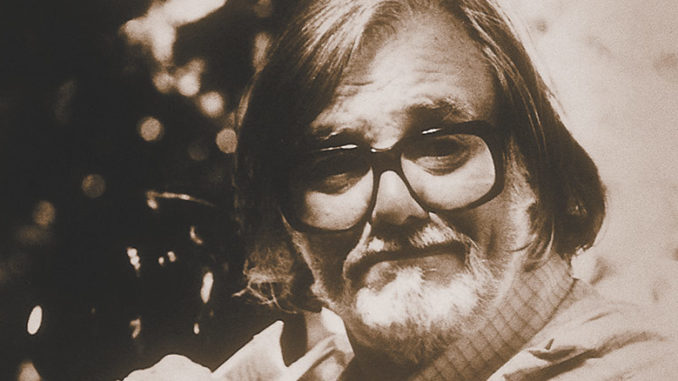
 Starz/Encore Group
Oh, those pesky zombies! At a time when our country was rocked by Vietnam protests, they terrified us in the low-budget splatterfest Night of the Living Dead (1968), then dropped out of sight for a decade before returning to attack rampant American consumerism in Dawn of the Dead (1978) and to devour some scientists in Day of the Dead (1985). Recently, with our country again caught up in a divisive war, they came lumbering back to take on the ivory tower powers-that-be in Land of the Dead (2005) and add new meaning to the idea of terrorism in Diary of the Dead (2007).
If you are reading this and wondering whether this feature is about politics or horror — well, it’s about a bit of both as writer/director George A. Romero, who wanted only to shock viewers, discovered that he’d created a body of work with some added meaning. And he had, he admits, a fine time doing it.
EFX artist Gregory Nicotero arranged an interview where Romero and I discussed his work, the politics contained in it and his nostalgia for the fly-by-night days of low-budget films.
I asked this question of Greg Nicotero also: What is it about Pittsburgh that makes it such an inspiration for horror film professionals?
George A. Romero: Gosh, you’re asking the wrong guy. I moved out of there about five years ago and I’m living in Toronto. What gave me the inspiration to do horror was New York City. I was a Spanish kid, or at least a kid with a Hispanic name, being beat up by the Italians. Meanwhile, my father, who was Cuban, hated the Puerto Ricans, so for me it was always “What’s going on here?” It was the Sharks versus the Jets when I was growing up. I went to Pittsburgh to go to school and stayed until five years ago when I came here.
And what got you up to Toronto?
We were making a film called Bruiser, which about nine people have seen, and at that time the Canadian dollar was a lot weaker than the American dollar so we came up here and met people and crews that were — even though they were in competing unions — wonderful and they wanted to work. For example, the third set decorators knew whether the character in the script would have this ashtray or that ashtray. I fell in love with the place.
It seems you can film just about anything up there.
Well, you can, particularly in the east. The west still drives Vancouver because [Vancouver is] close to L.A. There are hard times over here, particularly since the dollar values have collided. But I love it here. I love the people. I love the crews. That’s what it’s all about. I had been used to working with a family of people in Pittsburgh, and for a while Pittsburgh was the hot place and there were a couple of $400 million years. And everybody thought, “Wow! This is a whole new industry for Pittsburgh.” But then Hollywood discovered St. Louis, or wherever it went, and people wound up leaving because they couldn’t support themselves. And I found here an industry that is not going to go away. They are building studios that are real. I love the people and fell in love with the place. So I said, “OK, I’ll come up here.”
You and Tom Savini have been collaborators from the beginning. Could you comment on the interplay between the two of you and how you realize your collective vision, so to speak?
First of all, we were very close friends. We are still close friends, but I used to be able to say to Tom, “Hey, how do we kill a zombie in a unique way?” and Tom would come up with an idea. I loved that and it was a very collaborative relationship. The problem is that now Tom wants to be, I don’t know, more of an actor and is less interested in effects even though he runs a school for young effects people. But it’s different now, you know. A studio is not going to hire Tom because he is just a guy. And I think that’s what Tom got tired of. He’s a celebrity and we go to these conventions and Tom has the longest line in the room because people love him. I do, too, but he’s just not in that business anymore. But working with him was so easy, just so easy.
Your minds just meshed?
Exactly. I could call on him for anything and he would do it in two minutes. He’d say, “I know how to do this. We’ll take a soda straw, paint it silver, make it look like a screwdriver and shove it into this guy’s ear.” Tom’s solutions were simple, easy, quick and he understood the production process and he was just … you know, I can’t say enough about the guy. He’s a great guy.
Are you working with Greg Nicotero more these days?
Yes, because Greg has this company called KNB [EFX Group] and studios say, “We’ll use these guys and if they fail we can sue them.” It’s a terrible thing to say but that’s really what it is. I worked with Greg on several films when he was working for Tom and then Greg went on to form this big company and everybody trusts this big company instead of Tom.
You’ve stated that a huge budget — and, I suppose, by inference a lot of expensive effects — does not necessarily make for a good horror film. So what does?
You can’t buy creativity with money. Tom was a wonderfully creative guy and you could have a $100 million film and people that theoretically have all this experience coming on. But basically what you aren’t getting is that old-fashioned “paint a straw silver” mentality. People aren’t thinking that way. They’re thinking you can spend lots of money and make it better. And that’s not always the case. What’s missing always is the soul, and that becomes obvious sometimes. The biggest zombie film I ever made was Land of the Dead. Universal was great. The executives were great. They let us do what we wanted to do but there was too much money and we weren’t able to sort of get down, and do it down and dirty and make it fun.
What’s wonderful about that movie is the meaning, the politics, comes through. But in Night of the Living Dead, things are a lot more subtle. And that film has been dissected and studied, almost like a science project. What are some of the stranger interpretations of it you have seen?
[laughs] Oh, boy! You are asking me to really dig deep. I don’t remember; it’s been 40 years. But what I do remember is that with all the films, there would be people like Robin Wood who would find the meaning of something that I had done and write about it in great, eloquent terms and all that. And I would almost chuckle. That’s not to laugh at Robin. I think that probably he was right and a lot of it was instinctive, but it was only with Land of the Dead that most American cinema writers would say, “I can see that this is about George Bush and Rumsfeld and whoever the hell else.” … For a guy that has been doing this for about 35 years, I said, “Jesus, it’s about time you noticed.” [laughs] “I’m glad you noticed, but at the same time, why didn’t you notice a while ago?”
So what can I tell you? All of these films, the zombie films particularly, I’ve tried to find something to talk about behind the veil and I’ve always been a bit discouraged that it was only Europeans or Asians or whoever who noticed. I guess it’s the old thing. The hardest audience is always the home audience.
You did Land of the Dead in the middle of the Iraq war and Night of the Living Dead at the height of Vietnam. Do you really think the lumping proletariat is the army of the walking dead, and are we ever going to wake up?
No, I don’t think we will ever wake up. When we did the very first film, we thought we were making a horror film, pushing the envelope a bit and basically baring our political souls, [but] I don’t know whether we went too far with it because so much of the original film was an accident. We cast the lead guy, a black man, because he was the best actor among our friends. We never realized the implications until one of the producers, Russ Streiner, and I were driving to New York with the end print of the film in the trunk of the car. And that night on the car radio we heard that Martin Luther King had been shot. And we looked at each other and said, “Jesus, this film is a lot more powerful, suddenly.”
Prior to that, Duane [Jones] was the only guy on the set who realized what was happening. “Do you know what is going to happen to me? You’re asking me to slap a white woman. Do you know what is going to happen when I walk out of the theater? I’m going to get beat up.” The rest of us were going, “Come on, man, it’s the ’60s. Forget about it!” We didn’t ever think we were breaking ground. We were casting a black guy where most studios would never cast a black guy in this role. But when this guy went on the page, he was a white guy. And when we wrote the script the same things happened to him. The posse came and they shot him. The same thing happened in the film, but since he was black, it took on all this huge overwhelming importance. We never realized it — but Duane did.
When we made Night of the Living Dead … there was rioting in the streets over the war or police action or whatever we were calling it over there. And we were angry. But casting Duane, that had nothing to do with it. But two years after it played drive-ins and neighborhood theaters in the U.S., Asian cinema discovered this film and started to call it essential American cinema. I said right then, “I will never do this again. This is, like, too dangerous; I don’t know what ground I’m treading on.” I fled, basically, until I socially knew the people that built this shopping mall, this first big indoor temple to consumerism in the west Pennsylvania area. Suddenly a bell went off and I thought, if we want to do another one, this is the way to do it. People take refuge in a shopping mall. It’s the first time I said that the politics are, if not out front, at least underneath, and then we can make a fun movie.
It was completely serendipitous [that] within two weeks of me getting this idea, an Italian director, Dario Argento, called me up and said, “Wouldn’t you like to make another Living Dead movie?” And I said, “It so happens I have an idea.” And Dario said, “You will come here and I will put you in hotel.” And he put me in a hotel in Rome and he said, “You write. You write.” And in a hotel in Rome I wrote the script. It was only in that moment that I said, “OK, now this is my job. I’m the Michael Moore of horror. I’m gonna try to have some sociopolitical satire under this stuff and we can keep doing this forever.” And it’s really only then that I realized what I was doing. [laughs — a lot]
What was the first film you can recall that really frightened you?
The Thing, the Howard Hawks film I saw when I was first allowed to go to the movies alone.
And your favorite?
I always say this and people say I’m lying but it’s The Tales of Hoffman. And to me it’s scary because he falls in love with a mechanical doll and a vampire. And it was scary at the time, but I could also see how he was doing his effects. I was this young kid who’d only played around with my uncle’s 8 mm camera. So I knew you could shoot in reverse and you could double expose so that was the movie that made me say, “Wow! Maybe I could do this someday.” And I think that kept me going until I was able.
I hear you got your start with “Mister Rogers’ Neighborhood”?
I joke and said the scariest movie I ever made was “Mr. Rogers’ Tonsillectomy.” I loved Fred. He was the first guy that gave me a job as a shooter. … I went to college. I was a design major and transferred into the theater department and didn’t get any satisfaction over there, either. But I met people, though, who were interested in movies, so the few of us went out and started a company to make commercials. We made beer commercials, but the first job I did was with Fred Rogers. He was the most wonderful, dedicated guy even though he was a child, and I loved him for that. He said “George, I have this thing. The trolley comes by and we go to Picture Picture and I tell kids how they make light bulbs and you come and shoot how they make light bulbs.”
So I did all those Picture Picture things for him. And then he did this thing where he had a tonsillectomy because he didn’t want kids to be afraid when they go to the hospital. And I thought it would terrify kids, so I joke it was the scariest movie I ever made. We shot it and Fred rolled around in the wheelchair, which was all he wanted to do because it had wheels and he was a kid. … But we were trying to show kids that they could go to the hospital and have fun and not worry about whether they were going to die or something.
October is, of course, Romero’s month on television. He’s featured along with Tom Savini in the documentary Starz Inside: Fantastic Flesh premiering on Starz Oct. 7. His first zombie film, Night of the Living Dead, airs Oct. 25 on SCI FI Channel and The Dark Half airs Oct. 26 on AMC.
2 Trackbacks / Pingbacks
Comments are closed.